In brief
In a single night, Russia's Defence Ministry says it shot down 1,198 Ukrainian drones, the largest raid of the war by its own count, with 467 aimed at Moscow alone. Yet by morning the Lukoil refinery in Volgograd, about 5% of Russia's refining capacity, was burning again, its 13th hit since February last year, and four workers were dead. With long-range FP-1 drones costing roughly $55,000 each, point defence spread thin across thousands of kilometres, and up to a third of Russian refining disrupted, fuel limits are spreading across Russian regions just as Washington pushes a new round of talks that Europe has now been invited into.
Eight pm to eight am. 12 hours. And by Russia’s own count, 1,198 Ukrainian drones. They reached Moscow.
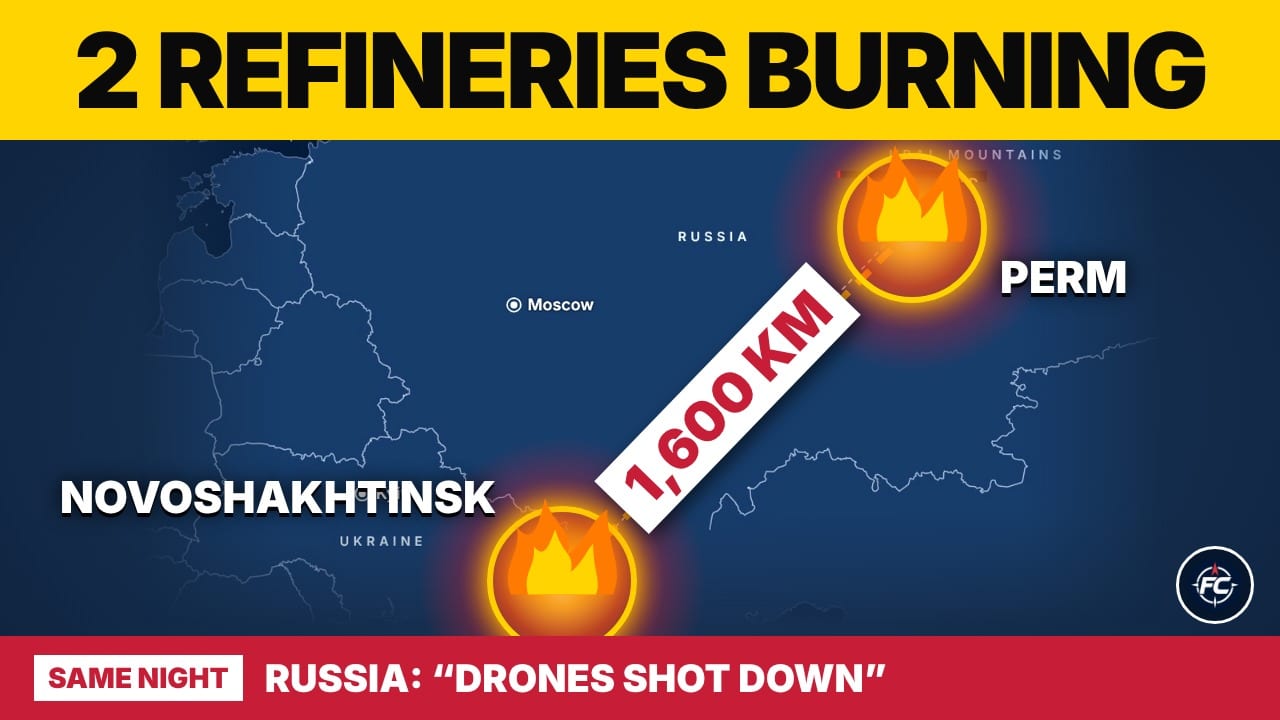
They reached Rostov. They reached Volgograd, more than 300 km from the border, where one of Russia’s largest oil refineries was soon burning in the night sky. And here’s the part that matters. This happened one day after Russian, Ukrainian and American negotiators left the table in Abu Dhabi.
On the very night American envoys were briefing Vladimir Putin in the Kremlin. Moscow wanted to talk about territory. Kyiv just reminded everyone what else is on the table.
The night, hour by hour
Let’s start with what we actually know, and who is saying it. The figure of 1,198 comes from Russia’s Ministry of Defence. It is a claim, not a verified number. Moscow only reports drones it says it shot down.
How many were really launched, we don’t know. Ukraine hasn’t confirmed the size of the operation. But the regional reports fill in the picture. Moscow’s mayor, Sergei Sobyanin, said 467 drones flew toward the capital region.
144 were shot down on the final approach to the city. All four Moscow airports were restricted overnight. So were Kaluga, Volgograd, Saratov, Penza, Tambov, Yaroslavl, Ulyanovsk, Orenburg and Orsk. Nine regional airports.
Plus the capital. In one night. In Kaluga, the governor reported 133 drones. In Rostov, more than 120.
A production facility caught fire. Five apartment buildings were damaged. In Voronezh, 32. Think about what that means for an air-defence network.
Every one of those drones has to be detected, tracked and engaged. Every interceptor fired at a drone is an interceptor that is not protecting something else. And every radar crew is working the same twelve-hour shift across a front that now stretches from the Black Sea to the edge of Siberia. That’s the real point of a mass launch.
Not every drone has to hit. Enough of them have to arrive at the same time.
Volgograd
And in Volgograd, enough of them did. Governor Andrei Bocharov confirmed a “massive” attack on the city, and fires in Volgograd’s southern industrial zone. Four workers were killed. Two more were injured.
The governor did not name the plant. But eyewitness video reviewed by the independent Russian outlet Astra points to one site: the Lukoil refinery that sits inside the city limits. This isn’t a minor plant. It processes around 15 million tonnes of crude a year.
That’s roughly 5% of all the refining capacity in Russia. And this wasn’t its first hit. On October second, a Ukrainian strike forced the refinery to halt crude processing completely. By one independent count, Thursday night was the thirteenth strike on this facility since February of last year.
By morning, drivers in Volgograd were already queuing at petrol stations. That image is the real target. A refinery fire burns for a day. A fuel queue tells a city that the war is no longer something on television.
The refinery campaign
Volgograd wasn’t an isolated strike. It was the latest move in a campaign that has been accelerating for weeks. Two days earlier, on November eleventh, Ukraine’s Special Operations Forces said they hit the Omsk refinery. Omsk is the largest refinery in Russia.
It’s more than 2,000 km from Ukraine. And it was the third time this year Kyiv has claimed a strike there, after July and October. The governor confirmed one person was injured. The scale of the damage is disputed.
Even an independent Russian outlet suggested some of the glow may have come from flare stacks. We’ll treat it as a claim. But here is what Ukraine’s General Staff says it has done since October thirtieth. Omsk.
Kirishi. Ryazan. Nizhny Novgorod. Yaroslavl.
Russia’s five largest refineries. In two weeks. According to the same source, a strike on Saratov on November seventh damaged its only primary processing unit, and the plant has suspended operations. Independent tallies point the same way.
Bloomberg counts eight Russian refineries attacked since the start of November, with a combined capacity of about 2.3 million barrels a day. And on November tenth, a Reuters estimate put the share of Russian refining capacity disrupted at around 30%. One independent ledger, kept by B N E IntelliNews, now counts 27 Russian refineries hit and more than 200 dated strikes. November had more refinery strikes in its first 13 days than October had in the whole month.
So when people ask why Ukraine keeps hitting oil, the answer is simple. Oil is how Russia pays for this war. Diesel is how Russia moves this war. And every refinery that goes dark has to be repaired with equipment that sanctions make harder and harder to buy.
The weapon: FP-1
So what actually flies more than 2,000 km to Omsk? Mostly, not missiles. Meet the F P one. It’s built by a Ukrainian company called Fire Point.
A fixed wing. A piston engine. No runway needed. It’s fired off a rail with a small rocket booster, and then it simply…
flies. Fire Point says the latest version can reach up to 3,400 km with a sixty-kilogram warhead. In twenty 25, it advertised 1,600. The company quotes a price of 55 to $1 per drone.
Those are the manufacturer’s numbers, not audited ones. But the scale is real. In twenty 24 alone, the Ukrainian state bought F P ones worth about 320 million dollars. Alongside it flies the Liutyi, built by Antonov.
It’s bigger and more expensive, at around $1 by press estimates. Now put that price next to the target. A primary distillation unit at a refinery is a custom piece of heavy industry. It takes months to repair, and many of its components are under Western sanctions.
Fire Point’s CEO put it bluntly. Delivering the drone and hitting the target, she said, are the easy part. The hard part is getting through.
Why Russia can’t stop it
And that brings us to Russia’s biggest problem. Russia’s air defence was built to stop aircraft and a handful of cruise missiles. Not hundreds of slow, low-flying drones arriving from every direction at once. According to an analysis by the independent outlet Meduza, Russia still has no detection network covering even all of its border regions.
Its sensors and its shooters don’t automatically share data. So it falls back on defending individual sites, one by one. And point defence has one weakness. It can be overwhelmed.
Here’s where Russia has made its choice. An open-source researcher known as Jembob, who tracks Russia’s short-range air defence, counted more than 60 new air-defence towers built around Moscow and Putin’s Valdai residence since March. Meanwhile, at refineries in Samara, Tolyatti and Syzran, he found no visible new short-range defences since February. Near Saratov, video suggests a single Pantsir system near the Engels strategic bomber base is also firing across the Volga to protect the city’s refinery.
One system. Two strategic targets. Even in Moscow, the strain shows. In June, a Pantsir was moved from the front line onto a tower at the Moscow refinery.
Photos showed it carrying two missiles on one side, out of a possible six. So Russia faces a choice it can’t win. Protect the capital and the president, or protect the refineries that pay for the war. On the night of November thirteenth, it tried to do both. Volgograd burned.
The fuel front
The damage doesn’t stay inside the refinery fence. On November ninth, Rosneft, Russia’s largest oil company, brought back limits on fuel sales at its stations in at least seven regions, from Karelia in the north-west to Buryatia near Lake Baikal. In one region, officials quoted the rules: 30 litres in cities, 50 on highways. No jerrycans.
The same day, drones hit the Kirishi refinery near Saint Petersburg. Kirishi processed about 6.5% of all Russian crude last year, and supplies roughly half the fuel used in Saint Petersburg. NASA’s fire-detection satellites picked up a large blaze on the site. Before that, Ryazan and Yaroslavl.
Two refineries that supply the Moscow region. Moscow’s answer has been to keep fuel at home. A general ban on fuel exports now runs until the end of January twenty 27. Russian diesel exports have fallen from around 1 million barrels a day in the first half of this year to around 550,000 since July.
That’s the trade-off the drones are forcing. Every barrel Russia keeps at home to stop the queues is a barrel it can’t sell abroad to fund the war. And there’s a twist here that almost nobody is talking about. In October, after talks between Putin and President Trump, Moscow carved out exceptions to its own ban.
Deputy Prime Minister Alexander Novak says Russia plans to export 2.15 million tonnes of diesel in November, up from just 510,000 in October. Part of that is meant for Western markets. So far, it hasn’t gone smoothly. Tankers have left the Baltic with vague destinations.
One of them turned toward the Bahamas. But here’s the real problem for that deal. The diesel Moscow promised to export has to be refined somewhere first. And Ukraine is hitting those refineries every night.
Why now: the talks
Now look at the calendar. On November tenth and eleventh, American, Ukrainian and Russian delegations met in Abu Dhabi. Then US envoys Steve Witkoff and Jared Kushner flew to Moscow to brief Vladimir Putin in person. From Moscow, they flew to Dublin to meet President Zelensky.
And while that diplomacy was moving, the drones were in the air. After the Kremlin meeting, Kushner announced that the next round of talks will include European countries, to address what he called “the broader postwar European security arrangements” alongside the territorial issues. He also said they are working toward the largest prisoner exchange of the war. Putin’s response was to warn against any foreign peacekeepers in Ukraine.
And the Kremlin said it wants to see “genuineness” before it accepts Europeans at the table. The EU’s foreign policy chief, Kaja Kallas, answered that Europe must not fall into Russia’s “traps”, and that a ceasefire is still the top priority. Here’s the logic underneath all of this. Russia comes to the table with one main argument: time is on our side.
Hold out long enough and Ukraine, and the West, will accept our terms. Ukraine’s answer is to make time expensive. Every week of talks that drags on is another week of refineries burning, airports closing and fuel queues forming deep inside Russia. That is leverage.
And it doesn’t need anyone’s signature. Did Kyiv time this strike to the talks? Officially, nobody has said so. But the message landed either way.
The other side of the same night
None of this happened in a vacuum. On the same night, Russia launched 117 drones at Ukraine. 63 of them were jet-powered. Ukraine’s Air Force says 80 were intercepted.
Impacts were recorded at 24 locations. In Kyiv, a downed drone set a six-storey medical facility on fire. 30 people were evacuated. In Odesa, two people were killed.
Across Ukraine, nine people were killed and 61 injured in a single day. And Ukraine’s grid operator put every consumer in the country on hourly power cuts. That’s the asymmetry of this war in one picture. Ukraine is aiming at the machine that funds the war. Russia is aiming at the people who have to live through the winter.
What to watch
So what comes next? First, the next round of talks. For the first time, Europeans will be in the room. Watch whether Moscow tries to split them from Washington, or tries to avoid the round altogether.
Second, fuel. If the Reuters estimate of 30% holds into the winter, the queues in Volgograd won’t be the last ones. Watch for new export bans and regional rationing. Third, the prisoner exchange.
If thousands of people really come home, that will be the first concrete result of this entire process. If it stalls, it will tell you how real these talks actually are. Russia went to Abu Dhabi to talk about land. Ukraine answered with 12 hours that reached from Moscow to the Volga.
At the table, both sides say they want peace. In the sky, the negotiation has already started.
Key points
- Record Drone NightRussia's MoD claims 1,198 drones downed overnight on 12–13 November; Moscow mayor Sobyanin reported 467 heading for the capital and 144 downed on approach. Ukraine has not confirmed the size of the raid.
- Volgograd Refinery HitThe ~15 Mt/yr Lukoil plant, roughly 5% of Russia's capacity, was struck for the 13th time since February 2025; regional officials say 4 workers were killed and 2 injured.
- Refinery CampaignUkraine's General Staff claims strikes on Russia's five largest refineries since 30 October, including Kirishi, Ryazan, Nizhny Novgorod, Yaroslavl and Omsk 2,500+ km away, plus Saratov on 7 November.
- The Cheap WeaponThe FP-1 flies up to ~3,400 km with a ~60 kg warhead at an estimated $55–75K per drone. Russia can't ring every refinery with Pantsirs, so it falls back on point defence and towers.
- Fuel Front & TalksRosneft has limited sales in 7 regions and Russia's petrol export ban runs to the end of January 2027, while Jared Kushner says Europeans will join the next round of talks and Kaja Kallas warns of "traps".
Sources
- Russian Ministry of Defence (Telegram/MAX)
- Moscow Mayor Sergei Sobyanin (Telegram)
- Volgograd Region Administration
- Ukraine's Unmanned Systems Forces (Telegram)
- Ukraine's General Staff
- Jared Kushner (X)
- @jembobineuse (X)
- EEAS press remarks (Kaja Kallas)
- Reuters
- Bloomberg
- bne IntelliNews
- Meduza
- Astra
- Kommersant
- TASS
- The Guardian
- AP
- United24.
All claims are attributed to their source on screen. Drone tracks, routes and the two schematics are illustrative. Sound effects: Mixkit (mixkit.co), Mixkit Sound Effects Free License Satellite imagery: NASA Earth Observatory, Blue Marble Next Generation Shaded relief, borders and rivers: Natural Earth (public domain) Front line: DeepStateMap Thumbnail portrait: kremlin.ru, CC BY 4.0 Footage: social media via Exilenova+ / Supernova+ / Astra, Kanal13, RaiNews, Russian pool, EU Audiovisual, AFP, Office of the President of Ukraine, State Emergency Service of Ukraine.
Spotted an error? Request a correction.