In brief
Late on Monday night, a Russian jet-powered drone crossed into Poland near the border town of Dorohusk, set off air-raid sirens across the Lublin region and turned back toward Ukraine. Poland's military says it authorised a shoot-down but held fire because of the risk to civilians. It came four days after three Russian Kh-101 cruise missiles crashed in eastern Poland — and Warsaw now says it assumes the incursion was deliberate.
Confirmed vs claimed ↓Poland’s army had permission to shoot it down. It did not. Late on Monday night, a Russian jet-powered drone crossed into Poland near the border town of Dorohusk, set off air-raid sirens across the Lublin region, flew over Polish villages for several minutes, and then turned back toward Ukraine. Four days earlier, three Russian cruise missiles crashed in the same part of Poland.
Warsaw now says it assumes this was deliberate. And while Poland watched the sky, Ukraine was counting its own losses: a residential building torn open in Zaporizhzhia, and around 60 Patriot interceptors, already paid for by Ukraine’s allies, reportedly still waiting for a signature in Washington.
Air-raid alert in the Lublin region
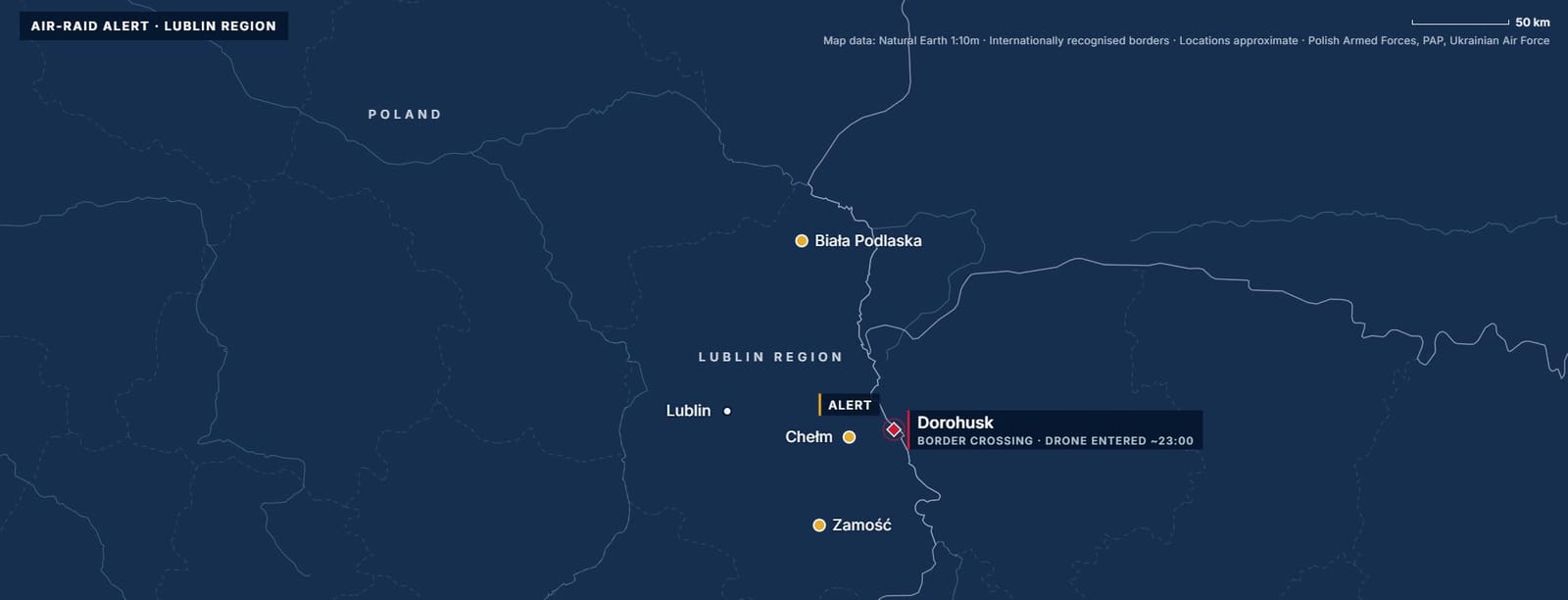
Start with the night itself. Russia launched another wave of drones at Ukraine on Monday evening, aimed in part at the west of the country, close to the Polish border. Around 11 pm local time, Poland’s Government Security Centre issued an air-attack alert for parts of the Lublin region in the east of the country. Sirens sounded.
Residents near the Ukrainian border were told to seek shelter. According to Polish reports, the warning covered 15 counties, plus the cities of Chełm, Zamość and Biała Podlaska. Within about an hour, the alert was lifted. By then, the object that triggered it had already come and gone.
Poland’s Armed Forces Operational Command then confirmed what many people living along the border already suspected. A Russian unmanned aerial vehicle had briefly violated Polish airspace.
Shoot-down authorised, fire withheld
Here is what the military said. In response to the threat, the Operational Command activated the necessary air defence forces and assets, and the situation was monitored in real time. The object was tracked by military radar throughout its flight. The commander authorised a shoot-down.
But after the drone changed course and headed east, the military decided to refrain from using weapons, citing the potential threat to civilians and the possible consequences of bringing the object down over populated areas. In other words, Poland had the target, the permission and the means, and chose to let it leave. The Operational Command added that its air defence forces remain on constant alert to respond to any threats.
What was the drone?
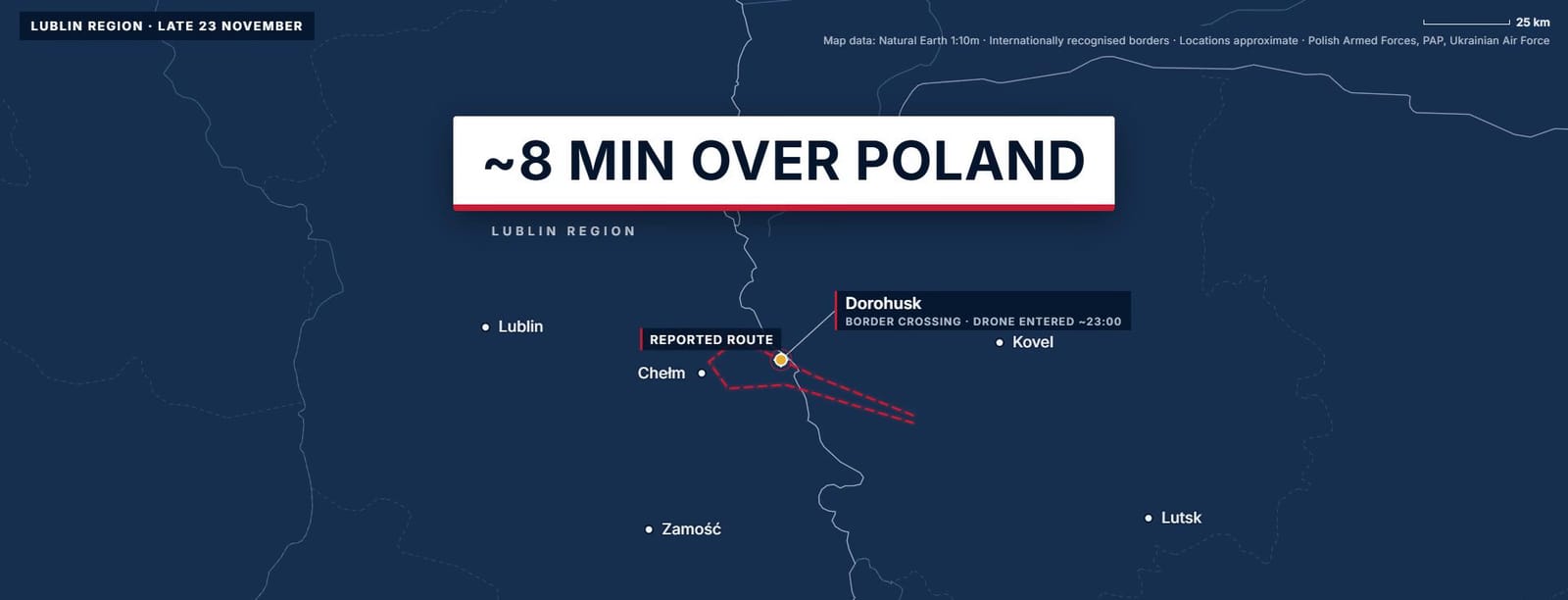
So what was it? Officially, Poland has only said it was a Russian unmanned aerial vehicle. The Polish Press Agency, citing the Defence Ministry, reported that it was a jet-powered reconnaissance drone, equipped with cameras. Some open-source accounts have called it a Geran-5, Russia’s new jet-powered attack drone, but no official has confirmed the type.
According to Ukrainian monitoring channels, it spent around eight minutes over Polish territory, looping over villages in the Lublin region before turning back toward Ukraine. Dorohusk is not a random spot on the map. It is home to one of the main road and rail crossings between Poland and Ukraine, a key route for freight, fuel and aid. A camera drone circling there is, at the very least, collecting information.
Warsaw: “we assume it was deliberate”
And that is how Warsaw is reading it. Poland’s Deputy Defence Minister, Paweł Zalewski, told the broadcaster RMF24 that Poland assumes the incursion was deliberate. He also said Poland does not know whether the drone was armed, or whether it was a decoy. That matters.
Russia uses cheap decoy drones in almost every attack on Ukraine, to soak up air defence missiles and map out where the defences are. A drone that enters NATO airspace, watches how the defenders react, and then leaves, gives Moscow useful information either way. If Poland fires, Russia learns how fast. If Poland does not, Russia learns where the line is.
Four days earlier: three Kh-101 missiles
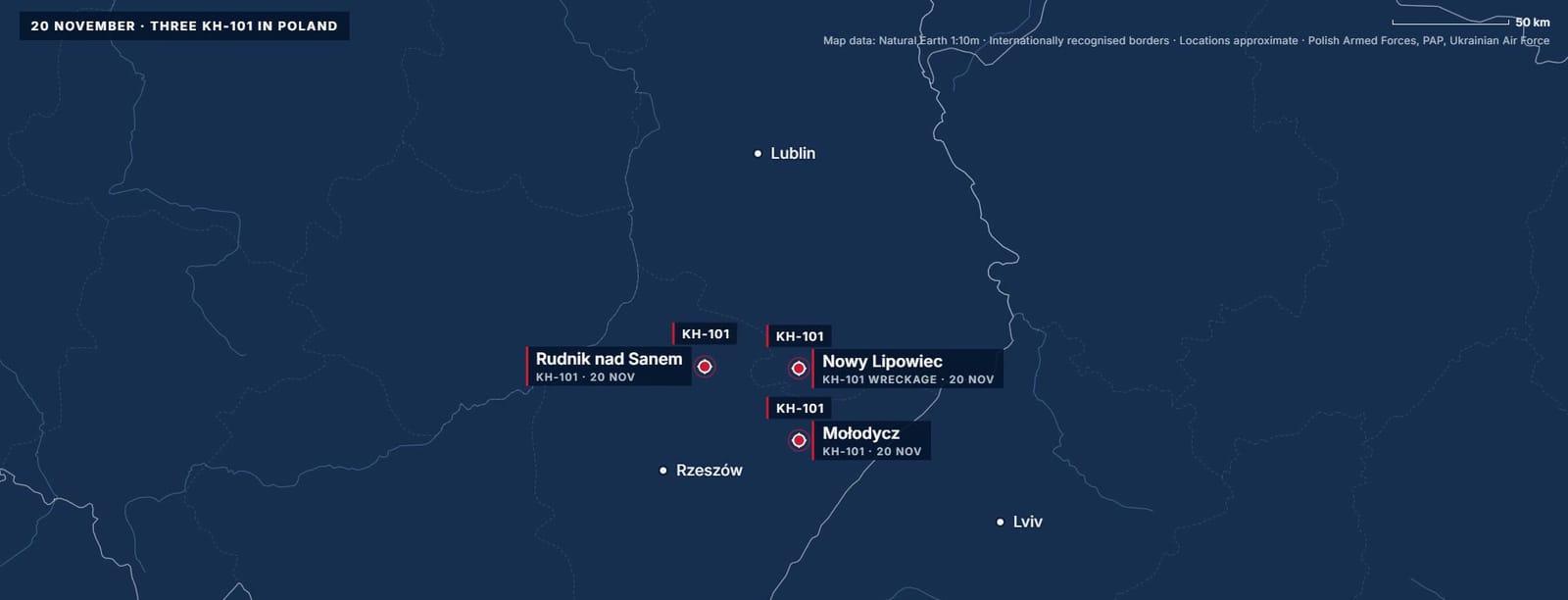
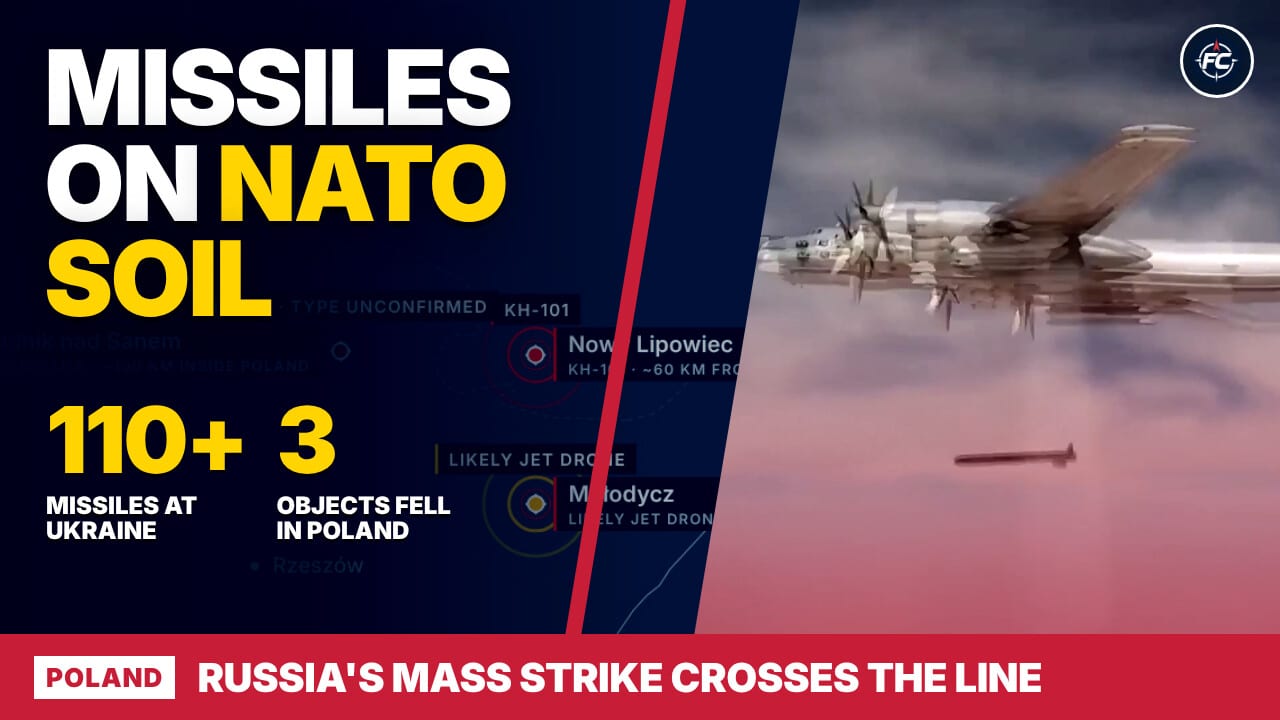
To understand why Poland is on edge, go back four days. On Friday, 20 November, during a massive Russian strike on Ukraine, three objects entered Polish airspace and crashed in the south-east of the country. Nobody was hurt. Over the weekend, prosecutors in Lublin confirmed that all three were Russian Kh-101 cruise missiles.
Wreckage of one of them, found near the village of Nowy Lipowiec, was manufactured in the fourth quarter of this year, which means it was brand new. Poland’s operational commander, General Ireneusz Nowak, said Polish radars tracked 11 potential threats that morning. A Swedish Gripen fighter patrolling under NATO command was cleared to shoot down one of the missiles, but the weather was so bad that the pilot could not identify the target, and held fire.
NATO sends an AWACS
NATO’s response came on Monday. After a meeting of NATO ambassadors in Brussels, the alliance authorised the deployment of an AWACS early-warning aircraft to Poland. Its rotating radar dome is designed to spot exactly the kind of low-flying targets, cruise missiles and drones, that ground radars struggle to see. Deputy Defence Minister Zalewski said it would give Poland better awareness and a better ability to respond.
NATO Secretary General Mark Rutte called the missile incident clearly dangerous, and a consequence of Russia’s ongoing war against Ukraine. Prime Minister Donald Tusk called it a provocation, and Warsaw plans to summon the Russian ambassador once the investigation is complete. And then, a few hours after that NATO meeting, the drone arrived.
Why not shoot?
Which brings us to the real question: why not shoot? It is a genuine dilemma, not a lack of nerve. A drone or missile shot down over Poland does not vanish. Its warhead and debris fall somewhere, and in eastern Poland that can mean villages, roads and farms.
Fighters and ground-based systems also need a clear identification before firing, and as the Gripen case showed, weather can make that impossible. Then there is cost. Many of the missiles NATO would use cost far more than a Russian drone. Poland has fired before.
In September 2025, when around 20 Russian drones crossed the border, Polish and allied jets shot several of them down. But every engagement is a trade-off between the risk of firing and the risk of not firing. Russia is testing exactly that trade-off.
Moldova, Finland, Transnistria
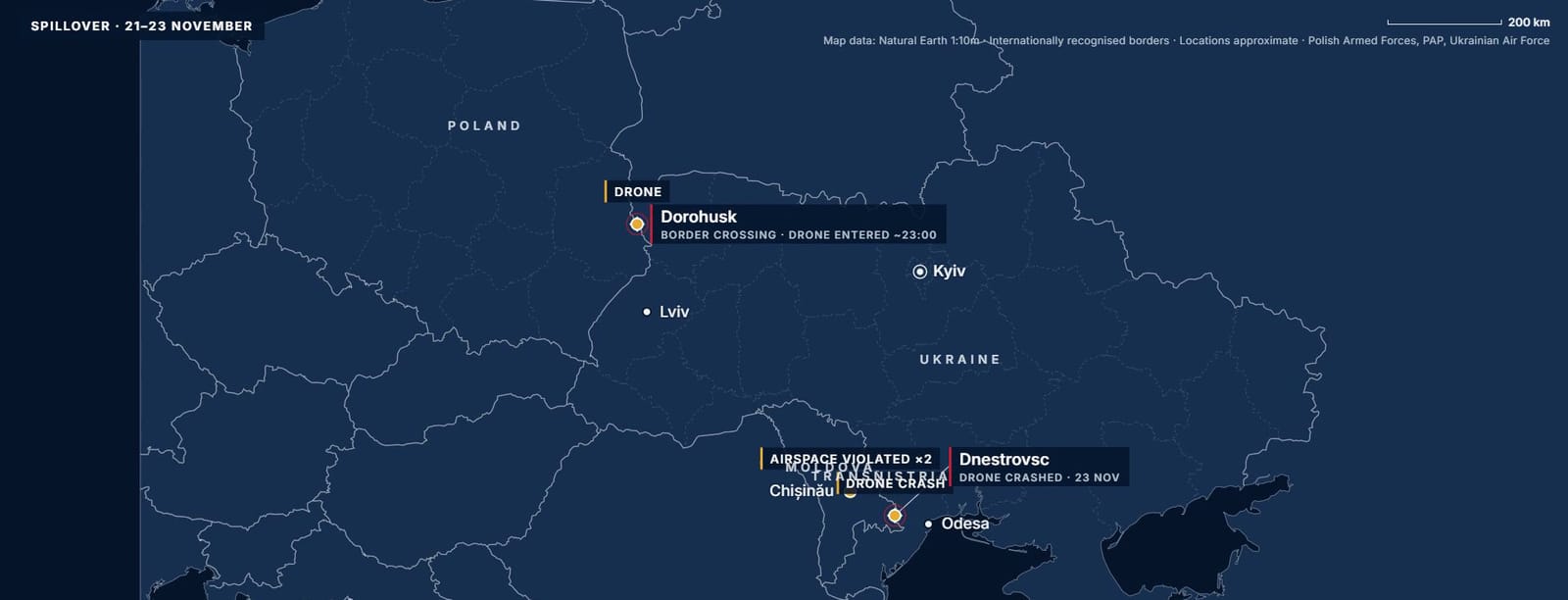
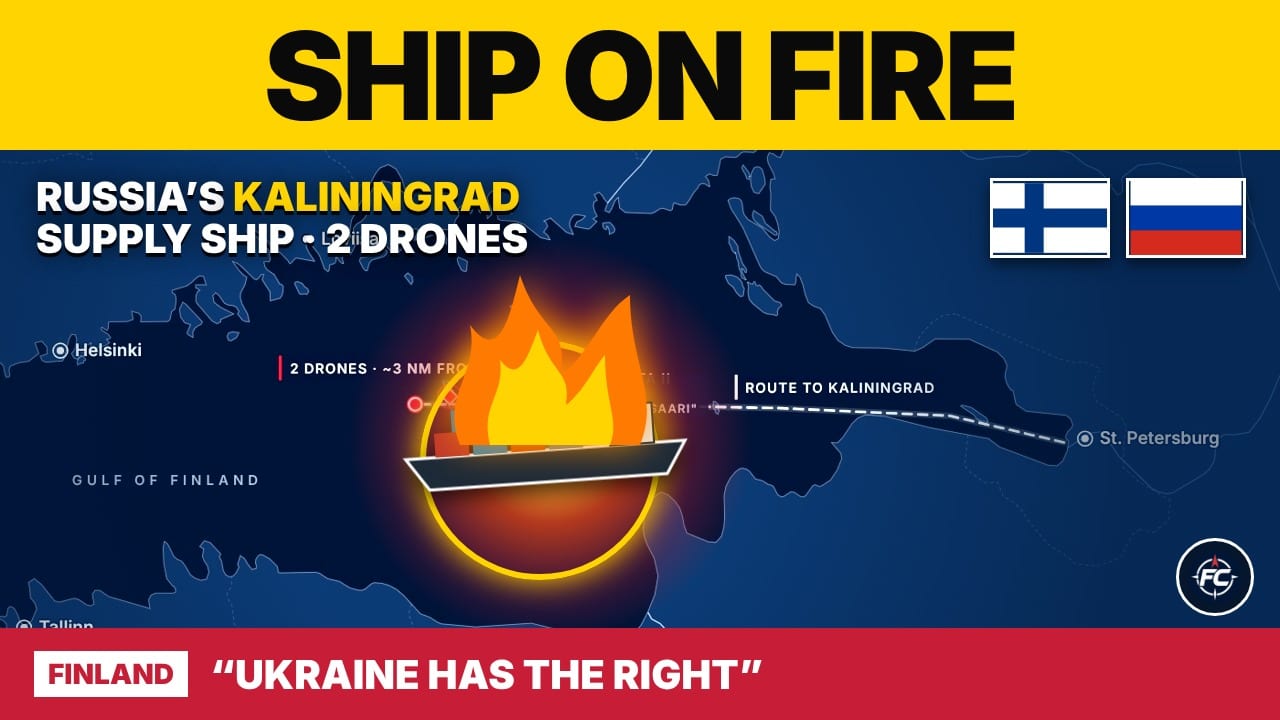
Poland is not the only neighbour seeing this. On Saturday, Moldova’s Defence Ministry said a Russian drone violated its airspace twice. The same day, Finland reported a suspected violation by a Russian helicopter near the coastal town of Loviisa, up to four kilometres inside Finnish airspace. And on Monday evening, Moldovan media reported that a drone crashed and exploded near the town of Dnestrovsc in Transnistria, the Russian-backed breakaway region on Ukraine’s border, starting a fire near a petrol station.
Neither the model nor the origin of that drone is known. But the pattern is clear. Russia’s air war on Ukraine keeps spilling over its edges.
96 drones over Ukraine in one night
Now look at the same night from the Ukrainian side. According to Ukraine’s Air Force, starting at six pm on Monday, Russia launched 96 attack drones of various types: Shaheds, Gerberas and Parodiya decoys. 64 of them were jet-powered Shaheds. By eight o’clock on Tuesday morning, air defence had shot down or jammed 73, including 45 of the jet drones.
But hits were recorded at 13 locations, and debris fell at two more, and the attack was still going on in the morning. Jet-powered drones matter here. They fly much faster than the old propeller Shaheds, which makes them harder for mobile fire teams with machine guns to catch, and pushes Ukraine to use more expensive missiles against them.
Zaporizhzhia: apartment block hit
In Zaporizhzhia, the night was deadly. Late on Monday, Russian forces struck a five-storey apartment building in the Kosmichnyi district, partly destroying it and leaving a huge hole in its side. A house nearby was also destroyed, and other apartment blocks, homes, cars and transport infrastructure were damaged. According to the head of the regional military administration, Mykhailo Semikin, at least two people were killed.
The number of injured rose through the morning, from 22 to more than 30, and later reports put it at around 40. Two children, aged 6 and 16, were among the wounded, and one person was in critical condition. Rescuers kept searching the rubble for more victims. Zaporizhzhia is regularly hit by guided glide bombs and drones.
One week: 165 missiles
And this was only one night. On Sunday, President Zelensky said that in the past week alone, Russia had launched around 2,700 attack drones, nearly 1,460 guided glide bombs, and 165 missiles of various types, against almost every region of Ukraine. He said a significant share of the missiles were ballistic, including missiles supplied by North Korea. In an attack late last week, at least 14 people were killed in the Kyiv region alone.
Ballistic missiles are the hardest threat to stop. They come in at extreme speed, on a steep path, with only minutes of warning. And for Ukraine, there is essentially one Western system that can reliably shoot them down.
Why Patriot matters
That system is the American Patriot. Its PAC-3 interceptors are designed to hit an incoming ballistic missile directly, and they are the backbone of the air defence around Kyiv and other major cities. But they are scarce. Each interceptor costs millions of dollars, production is limited, and the United States, Europe, Israel and Gulf states all compete for the same stock.
According to Zelensky, Ukraine received an average of about 12 Patriot interceptors a month from the United States this year. Compare that with 165 missiles in one week, and the problem becomes obvious. Even with other systems helping, every interceptor counts.
FT: ~60 Patriot interceptors on hold
Which is why this week’s report from the Financial Times landed so hard. According to the newspaper, about 60 Patriot interceptors that the United States had already agreed to supply to Ukraine are still waiting for Pentagon approval to be shipped. They include PAC-3 and older PAC-2 missiles, some of them sitting in European arsenals, and they are being paid for by Ukraine’s Western partners. Two Ukrainian officials and a third person familiar with the matter told the FT that the deliveries were being held up by Defence Secretary Pete Hegseth.
The reports we have seen include no public explanation from the Pentagon. Zelensky has been raising this since mid-October. On Sunday he said it was particularly difficult to understand the delays in delivering anti-ballistic systems to Ukraine.
Who pays, and who signs (PURL)
How does that work? Because Patriot missiles are American, Washington has to approve every export, and every re-export, even when the missiles are already in a European country’s stockpile and even when someone else is paying. Many of these deliveries go through a NATO mechanism called PURL, the Prioritised Ukraine Requirements List, under which European allies buy American weapons for Ukraine. Just last week, on 17 November, Germany and Norway announced a new PURL package focused on PAC-2 and PAC-3 missiles, with Germany putting in 300 million dollars.
Britain announced a separate package of more than a thousand short-range air defence missiles. Europe is paying. The question is whether the missiles are allowed to move.
One air war, two sides of a border
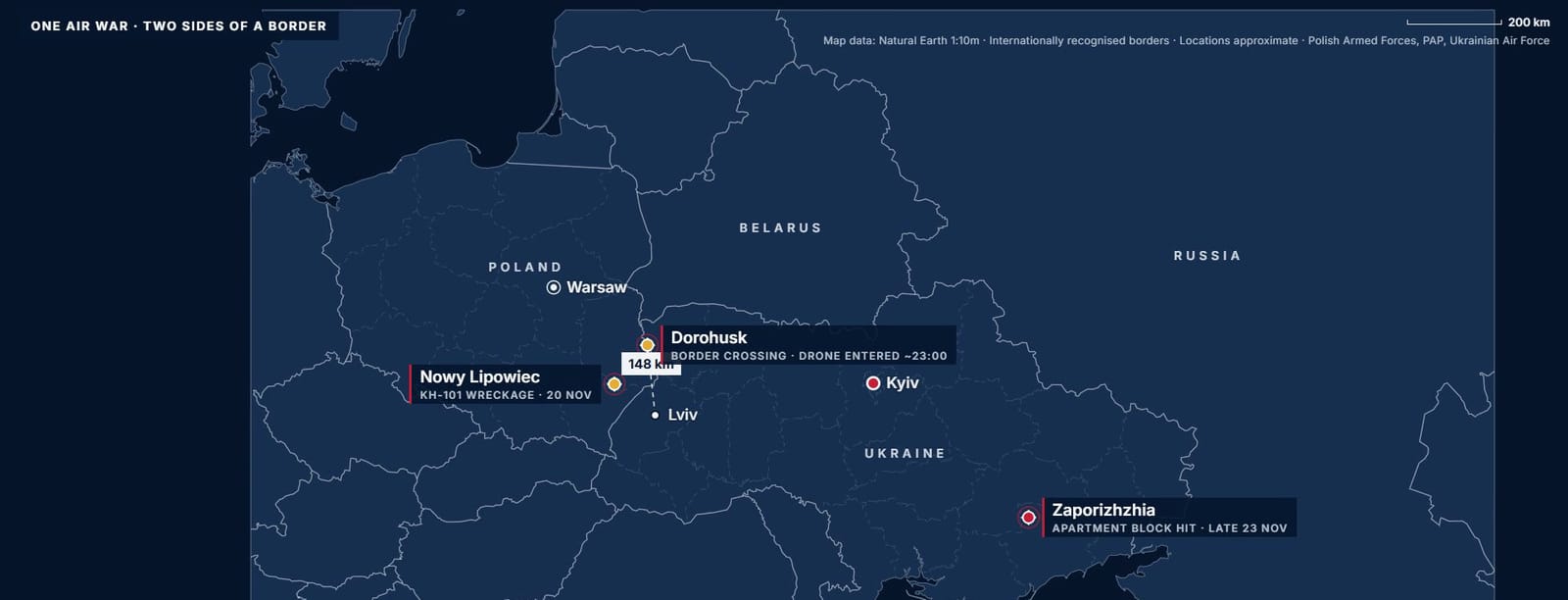
And this is where the two stories meet. Poland’s problem and Ukraine’s problem are the same problem, seen from two sides of a border. Russia is firing more missiles and faster drones than defenders can comfortably handle. Every interceptor Ukraine does not have means more Russian weapons get through to Ukrainian cities.
Every Russian salvo aimed at western Ukraine means more missiles and drones flying close to Poland, some of which stray, or are sent, across the line. NATO is now adding radar planes and air patrols on its side of the border. But the first layer of NATO’s eastern air defence is, in practice, Ukraine’s air defence. When Ukraine runs short, its neighbours feel it.
Confirmed vs. reported
Let us separate what we know from what is claimed. Confirmed by Poland’s military: a Russian unmanned aerial vehicle briefly violated Polish airspace late on Monday, a shoot-down was authorised, and fire was withheld after the drone turned east. Confirmed by Polish prosecutors: the three objects that crashed in Poland on Friday were Russian Kh-101 cruise missiles. Confirmed by NATO: an AWACS aircraft will be deployed to Poland.
Reported but not officially confirmed: the drone’s type, its reconnaissance role, and the eight minutes it spent over Poland. Reported by the Financial Times, citing unnamed sources: around 60 Patriot interceptors are being held up, reportedly by the Pentagon’s leadership. And unknown: the origin of the drone that crashed in Transnistria.
Our assessment
Here is our assessment. First, this looks like probing. A camera drone over a key border crossing, days after three cruise missiles, and hours after NATO announced new measures, is consistent with Russia testing how Poland and NATO react, though we cannot know Moscow’s intent for certain. Second, Poland’s decision not to fire was defensible on safety grounds, but it also shows the limits of current rules: an intruder that turns back in time can come and go.
Expect pressure to change that, including calls to intercept threats earlier, before they reach NATO territory. Third, the Patriot delay is not a small paperwork issue. In a week of 165 Russian missiles, 60 interceptors could decide whether some of those missiles reach a city.
What to watch next
First, Warsaw: whether the Russian ambassador is summoned, and whether Poland changes its rules for engaging intruders. Second, NATO: when the AWACS arrives, and whether allies add more fighters or ground-based air defence along the eastern flank. Third, Washington: whether the Pentagon releases the Patriot interceptors, and whether it explains the delay. Fourth, Russia’s next mass strike on western Ukraine, and whether more drones or missiles cross into Poland, Moldova or Romania. And fifth, the investigation in Transnistria: who launched the drone that crashed there, and why.
This has been Frontline Compass.
Confirmed vs claimed
How we label- ConfirmedA Russian UAV briefly violated Polish airspace late on 23 Nov; a shoot-down was authorised, fire withheld after it turned east — Polish Armed Forces
- ConfirmedThe three objects that crashed in Poland on 20 Nov were Russian Kh-101 cruise missiles — Lublin prosecutors
- ConfirmedAn AWACS early-warning aircraft will be made available to Poland — NATO
- ClaimedReported, not officially confirmed: drone type (jet-powered reconnaissance, per PAP), ~8 minutes over Poland (Ukrainian monitors)
- Reported~60 Patriot interceptors on hold; no public Pentagon explanation in the reports — Financial Times, unnamed sources
Sources
- Polish Armed Forces Operational Command (X)
- PAP
- RMF24
- Rzeczpospolita
- Notes from Poland
- Reuters
- Bloomberg
- ABC News
- Kyiv Independent
- Kyiv Post
- Ukrinform
- Interfax-Ukraine
- Ukrainian Air Force
- Zaporizhzhia Regional Military Administration
- President Zelensky (X/Telegram)
- Financial Times (via APA)
- Al Jazeera
- NBC News
- IPN (Moldova)
- European Pravda
- Janes
- Photos marked "file" are archive images used for context, not of the events described. Maps: Natural Earth. Positions and routes approximate.
Images & footage: Google Earth (imagery providers shown on screen); Wikimedia Commons — Rakoon (CC0), Janusz J. (CC BY-SA 3.0), Grzegorz W. Tężycki (CC BY-SA 4.0), loza_d (CC BY 3.0), Dutch Ministry of Defence (CC BY-SA 4.0), Ukrainian Air Force (CC BY 4.0), Security Service of Ukraine (CC BY 4.0), National Police of Ukraine (CC BY 4.0), State Emergency Service of Ukraine (CC BY 4.0), Office of the President of Ukraine (CC0), Russian Ministry of Defence (CC BY 4.0), Julian Herzog (CC BY 4.0), Simon Butler (CC BY 2.0), JIP (CC BY-SA 4.0), General Staff of Ukraine (CC BY 4.0); U.S. Air Force, U.S. Army, NATO / DVIDS, Airman Magazine, U.S. Department of Defense (public domain).
Spotted an error? Request a correction.